
The Great Off-Road Dilemma: Why Your Wallet (and Your Ego) Prefers Lumens Over Lockers
- Michael Timmons
- Mar 24
- 4 min read

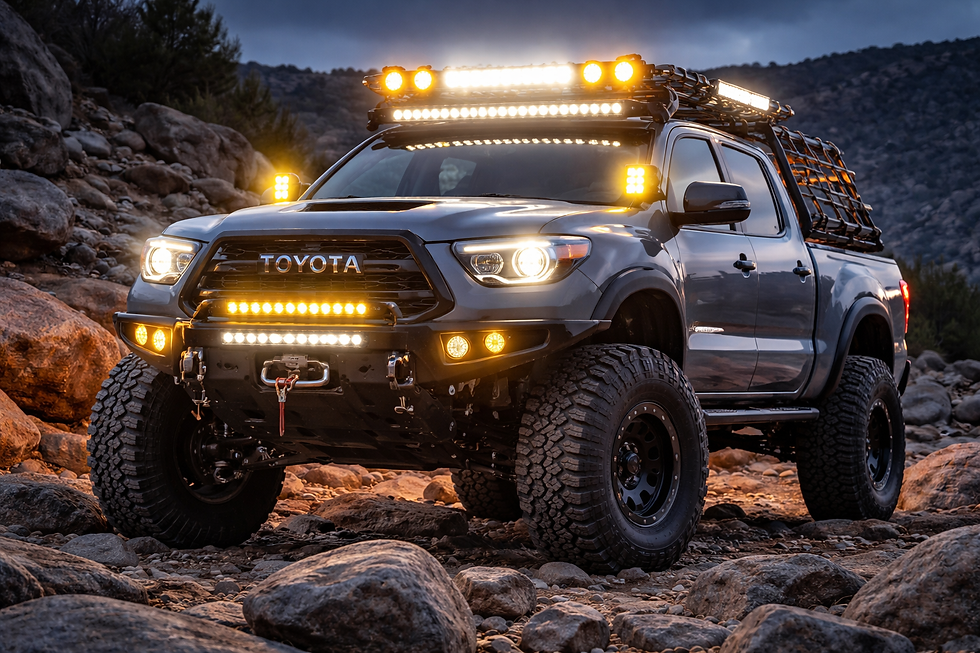
In the dusty, high-octane world of off-roading, there is a theological schism that divides base camps more than a broken axle ever could. It's the age-old debate: Do you invest in a locker to conquer the obstacle, or do you buy enough LED light bars to melt the retinas of a low-flying hawk? While the "purists" will tell you that traction is king, they are usually saying this while lying on their backs in a puddle of gear oil. The truth is simpler: lights are the superior first modification, and it isn't even a fair fight.
Let's talk turkey (cash), or rather, the lack of it in your bank account. A high-quality, selectable locker will set you back anywhere from $1,000 to $1,800, and that's before you realize you may need a compressor to run it, installation, and lockers for both the front and rear. Meanwhile, a decent set of auxiliary pods or a 50-inch light bar can be snagged for $150 to $1,000 (or $ 2,500 for high-quality). You can essentially turn your truck into a rolling sun for the cost of shipping a pair of lockers to your house. When you're at the local meet, nobody can see your expensive internal gears, and an ARB sticker is free. But they can certainly see your 20,000-lumen "Delete the Night" setup from three counties away.
The installation process is where the locker dream dies for the average weekend warrior. Installing a locker involves "backlash," "bearing pre-load," and "shimming," words that should only be uttered by people with engineering degrees and a very specific type of patience. One wrong move and your differentials become a very expensive metal blender. In contrast, installing lights is basically "red to red, black to black, and try not to drill a hole through your radiator." If you can operate a zip-tie, you are overqualified to install a light bar.
Then there is the "Usage-to-Regret Ratio." The average off-roader engages their lockers maybe four times a year, usually for thirty seconds to get over a rock that they probably could have bypassed with better tire pressure. Lights, however, are used every single time the sun dares to set. Whether you're setting up camp, looking for the dropped 10mm socket in the grass, or just trying to find the driveway after a long day of "scenic bypasses," those LEDs are putting in overtime.
Let's be honest about the "cool factor" on the trail. When you engage an air locker, you hear a faint click-hiss, and you move forward three feet. It's subtle. It's understated. It's boring. When you flip the switch on a quad-row light bar, you effectively declare war on the moon. You aren't just driving; you are a celestial event. You become the lighthouse for every lost Toyota (and Jeep Compass) within a twelve-mile radius. Lockers help you find traction; lights help you find your dignity when you're looking for the cooler at 11:00 pm.
Technically speaking, lockers are designed to help you go over obstacles. This sounds great until you realize "going over" usually leads to "breaking things." A locker gives you the confidence to put your high-dollar drivetrain against a 500-million-year-old rock. The rock usually wins. Lights, on the other hand, provide the tactical advantage of being able to see the "optional" line. Why risk a snapped axle shaft on a vertical ledge when you can clearly see the perfectly flat bypass ten feet to the left?
We must also consider the "Mall Crawler" ecosystem. Let's face it, most of them spend 90% of their time on pavement. A locker on the highway is a dormant, heavy paperweight that slightly lowers your fuel economy. But lights? Lights are a lifestyle. A set of amber dust lights says, "I might be at a Starbucks right now, but I could be in the Mojave by midnight." It's about the implication of adventure, and nothing implies adventure more than a roofline that glows like a UFO.
There is also the safety aspect. If you get stuck in the mud with lockers, you are just stuck in the dark with four wheels spinning. If you get stuck with a massive light setup, you have essentially created a rescue beacon visible from the International Space Station. You aren't "stuck"; you are "conducting a stationary illumination test." It's much easier for your friends to find you for a recovery when your rig is glowing with the intensity of a thousand burning suns.
Pricewise, the "Light Side" wins the long game. For the price of one rear locker and the professional labor to install it, you could buy a front light bar, ditch lights, rock lights, and a set of camp lights, with enough money left over for a high-end cooler. You're trading a hidden mechanical part for a total atmospheric transformation. It's the difference between buying a new engine part and buying a whole new personality for your vehicle.
In the end, the choice is clear, mostly because of the 50,000 lumens we just installed. While the locker crowd is busy measuring gear patterns and worrying about air leaks, the light crowd is already at the campsite, easily seeing their steaks on the grill and spotting the "easy way" around every boulder. So, save your pennies, skip the differential teardown, and buy more LEDs. After all, if you can't see the obstacle, it's not there, right?
This article is for entertainment only. My true view is that lockers should come first, but I wrote this as a devil's advocate. I'm an analog type of person, so I'm a fan of Eaton Detroit Trutrac's for the front and rear, both on the highway and off-road.


Comments