
“Loyalty is Often Fear, Wearing a Nicer Jacket” – Not my quote, but I like it. So what does it mean to me?

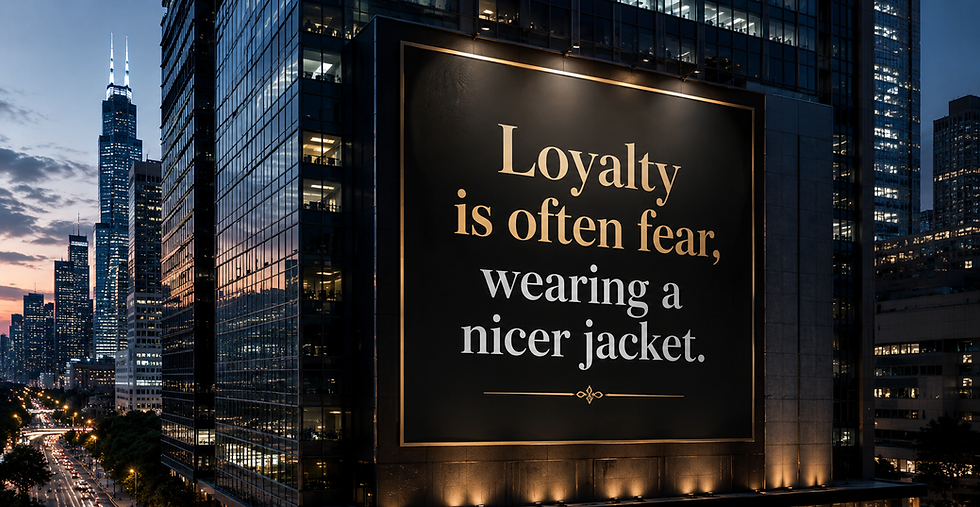
One of the more uncomfortable truths in leadership is this: what many leaders call loyalty is often something else entirely. The phrase, “Loyalty is often fear, wearing a nicer jacket,” challenges a deeply rooted assumption in business. It forces CEOs, executives, and managers to ask an uncomfortable question: Are people truly loyal to your company, your leadership, and your vision… or are they simply afraid of what happens if they are not?
At the executive level, loyalty is often praised as a cornerstone of organizational culture. Leaders want loyal teams. Investors want loyal executives. Companies want loyal employees. On the surface, loyalty sounds like a positive force. Commitment, trust, and alignment. But in many organizations, what appears to be loyalty is actually fear disguised as commitment. Employees stay quiet because they fear retaliation. Leaders avoid difficult conversations because they fear conflict. Teams remain compliant because they fear job loss, rejection, or uncertainty.
This dynamic becomes especially dangerous when fear is mistaken for healthy alignment. A CEO may look around the boardroom and see agreement from every executive. Everyone nods. Nobody challenges the strategy. No one raises concerns. It may feel like loyalty to leadership, but often it is the fear of speaking up. Fear creates silence, and silence can be costly. Some of the biggest business failures in history happened because people saw problems early but stayed quiet.
From an employee's perspective, this fear can show up in subtle but powerful ways. An employee may think, “I know this strategy won't work, but if I say something and leadership doesn't like it, I could damage my reputation." Another may feel burned out, under-supported, or frustrated, but chooses silence because they fear being labeled difficult or not a team player. Over time, fear-driven behavior creates a culture of compliance rather than innovation.
True loyalty looks very different. Real loyalty is not passive agreement. Real loyalty includes honesty, even when the truth is uncomfortable. The most loyal employees are often the ones willing to challenge leadership when they see risk, inefficiency, or blind spots. They care enough about the company's future to speak up. They are not protecting themselves; they are protecting the business and their team. That kind of loyalty is rare, but it is invaluable.
As CEOs, this means we must create environments where truth is safer than silence. Employees should not feel punished for respectfully challenging ideas, raising concerns, or offering different perspectives. Strong leaders do not surround themselves with “yes” people. They build teams that value candor, accountability, and trust. The healthiest organizations are not the ones with constant agreement—they are the ones with productive tension and honest communication.
Consider two different leadership environments. In the first company, the CEO rules through pressure, control, and intimidation. Performance is high in the short term, but the culture is driven by fear. Employees comply, but creativity drops. Innovation slows. Turnover rises. People do what they are told, but rarely more. In the second company, the CEO sets high standards while fostering trust and transparency. Expectations are clear, accountability is strong, but employees feel safe bringing ideas and concerns forward. Both organizations may appear disciplined from the outside, but only one creates sustainable growth.
Employees often know the difference immediately. In fear-driven cultures, people constantly calculate risk. Should I speak up? Should I disagree? Will this hurt me? In trust-driven cultures, employees ask different questions. How do we improve? How do we solve this? What's best for the company? The mindset shift is profound. Fear narrows thinking. Trust expands it.
The strongest leaders understand that loyalty cannot be demanded; it must be earned. Titles may command authority, but they do not automatically earn trust. Loyalty built on fear disappears the moment fear loses its power. Loyalty built on trust remains strong even during adversity. That is the kind of loyalty every CEO should seek.
At the end of the day, leaders should ask themselves one question: If fear disappeared tomorrow, would my people still follow me? The answer reveals everything. If they stay because they trust your leadership, believe in the mission, and respect the culture, you have built something powerful. If they stay only because they fear consequences, then what looks like loyalty may simply be fear wearing a nicer jacket.


Comments